Natural Beekeeping

Top Bar ApiRevolution has begun! Lets make some inexpensive Top Bar Hives and let them be pesticide free on their own natural comb! Che Guebee is a rebel bee fighting for the survival of the Biodiversity we all depend on and which is seriously endangered by deforestation and mono-crop agriculture! What kind of teaching have you got if you exclude nature?

Sunday, April 28, 2013

Save the bees: British beekeepers protest outside Parliament to call for pesticide ban


LONDON - Scores of worried beekeepers — and a brace of fashionistas — have gathered outside Britain's Parliament in a bid to convince the government to back a ban on pesticides that have been blamed for a worrying drop in bee populations.

The demonstrators say they hope to influence Britain's vote next week on a proposed European Union ban on some pesticides.

Some wore beekeepers' protective costumes or bright bee-like stripes to underscore their point.

Researcher Robert Mitton said Friday there has been a "rapid decline" in bee population and diversity since the pesticides came into use in the 1990s.

Fashion designers Vivienne Westwood and Katharine Hamnett delivered a petition supporting the ban to Prime Minister David Cameron's residence.

The British government has previously abstained from votes on the EU proposal.
Source
British fashion designer Vivienne Westwood holds up a sign supporting bee-keepers as she joins a demonstration outside the Place of Westminster in support of apiarists and their campaign to show public opinion ahead of the European Commission vote on the proposal to ban bee-harming neonicotinoid pesticides, in London, Friday, April, 26, 2013. (AP Photo/Alastair Grant)
Over 2 million Avaaz.org members voted for the ban on Neonicotinoids. Will Peterson ignore this? If so is this really Democracy?
 
Without Bees there will be no food. What then? Do we want to be the generation that killed life on Earth? If not then lets ban the Neonicotinoid killing pesticides! Why wait? Light up the darkness! Act NOW!

Saturday, April 27, 2013

Hollow Oak Trees

We Have Won !!! Germany votes for a ban on Neonicotinoids!


Berlin - In the debate over the protection of bees, Germany has indicated its willingness to support a partial ban of certain pesticide, before the crucial EU vote takes place on Monday April 29th.

"The federal government will agree to the neonicotinoids ban when voting on Monday in Brussels," said the spokesman of German Agriculture Minister Ilse Aigner (CSU).

The prerequisite for this is mainly "a clarification from the EU Commission that Germany, in the areas that go well beyond the European standard of protection, can retain a higher level of protection for bees."

The European Commission wants to ban the use of three neonicotinoids pesticides manufactured by the German company Bayer and other manufacturers like Syngenta, for the cultivation of corn, sunflower, canola, and cotton for two years, since these chemicals are suspected of causing bee deaths.

For the duration of the ban, the use of these pesticides for winter crops and plants that attract bees will not be allowed. The earlier vote of the EU Council of Ministers in March, produced a stalemate, partly because Germany abstained during that vote. The decisive vote for the EU will take place at the Appeals Committee on Monday April 29th.

German Agriculture Minister Aigner's spokesman explained that Germany abstained in March so that the current proposal of the European Commission could reassure the Federal Government "that it would not interfere with the existing high level of protection for bees in Germany". Germany had already significantly restricted the use of these controversial pesticides, called neonicotinoids, in 2009. These higher national standards, used in Germany, will not now be lowered as a result of EU legislation, and was guaranteed by the EU Commission.

Environmental organizations had expressed grave concern that Germany could block the EU proposal to ban the pesticides under pressure from the agricultural industry.

"The accusation that Germany would block the protection of bees, is completely absurd and baseless," replied Aigner's spokesman.
Source; original article written in German

Friday, April 26, 2013

Roundup, An Herbicide, Could Be Linked To Parkinson's, Cancer And Other Health Issues, Study Shows


April 25 (Reuters) - Heavy use of the world's most popular herbicide, Roundup, could be linked to a range of health problems and diseases, including Parkinson's, infertility and cancers, according to a new study.

The peer-reviewed report, published last week in the scientific journal Entropy, said evidence indicates that residues of "glyphosate," the chief ingredient in Roundup weed killer, which is sprayed over millions of acres of crops, has been found in food.

Those residues enhance the damaging effects of other food-borne chemical residues and toxins in the environment to disrupt normal body functions and induce disease, according to the report, authored by Stephanie Seneff, a research scientist at the Massachusetts Institute of Technology, and Anthony Samsel, a retired science consultant from Arthur D. Little, Inc. Samsel is a former private environmental government contractor as well as a member of the Union of Concerned Scientists.

"Negative impact on the body is insidious and manifests slowly over time as inflammation damages cellular systems throughout the body," the study says.

We "have hit upon something very important that needs to be taken seriously and further investigated," Seneff said.

Environmentalists, consumer groups and plant scientists from several countries have warned that heavy use of glyphosate is causing problems for plants, people and animals.


The EPA is conducting a standard registration review of glyphosate and has set a deadline of 2015 for determining if glyphosate use should be limited. The study is among many comments submitted to the agency.

Monsanto is the developer of both Roundup herbicide and a suite of crops that are genetically altered to withstand being sprayed with the Roundup weed killer.

These biotech crops, including corn, soybeans, canola and sugarbeets, are planted on millions of acres in the United States annually. Farmers like them because they can spray Roundup weed killer directly on the crops to kill weeds in the fields without harming the crops.

Roundup is also popularly used on lawns, gardens and golf courses.

Monsanto and other leading industry experts have said for years that glyphosate is proven safe, and has a less damaging impact on the environment than other commonly used chemicals.

Jerry Steiner, Monsanto's executive vice president of sustainability, reiterated that in a recent interview when questioned about the study.

"We are very confident in the long track record that glyphosate has. It has been very, very extensively studied," he said.

Of the more than two dozen top herbicides on the market, glyphosate is the most popular. In 2007, as much as 185 million pounds of glyphosate was used by U.S. farmers, double the amount used six years ago, according to Environmental Protection Agency (EPA) data.
Source

Wednesday, April 24, 2013

Che Guebee Log Hive

It was not my plan to make this log into a bee hive this year but as with many things in my life inspiration has the last word. So I went ahead and turned this log I've got last year into a vertical log hive. This log's walls are between 35 mm and 90 mm thick and is approx 137 liters in volume (70 cm tall).
Feral Honey Bee Colony is often found in hollow trees and it seems to be their main preference but they can be found in other hollow places like an attic, outdoor toilet, barrel, etc ...
Im hoping to get a feral swarm move into it this year.
I placed a solid floor onto the log so mice cant get in
placed a few oak branches across the log to support the comb
placed a 5 cm layer of pine wood shavings to mimic the hollow tree floor which is full of debris in which microorganisms and other beneficial insects can hide.
then I seeded the hive floor with rotten material found inside this tree to add microorganisms
then I sprinkled crushed propolis onto the wood shawings to create hive smell. Bees prefer to move into hollows which already housed bees in the past. I even used a few drops of Lemongrass Essential Oil as swarm lure which mimics their Nasonov pheromone.
I melted a few bees wax guides to add more hive smell to the log
bees can start building the comb on these planks. I can also replace those for top bars in case I want to transfer one of my old Queens into it from my kenya top bar hives
Big flat rock as the roof. Lets see whether it keeps the rain out of the hive.
Nails are there to stop the birds from nesting in the log. This top entrance hole is 40 mm in diameter.
Lets see if this log hive can attract a swarm :)

Tuesday, April 23, 2013

Log hive and the flowering Spring

I've got a hollow log last year from a man who builds drums. He planned to build a bass drum out of this log but as he said it seems as it was waiting for me to get it since he had it for 2 years and never got around to turn it into a bass drum :)
I dont know if Im going to keep bees in it this year but will place it outdoors and hope for a swarm to move in.
I placed the hive on a huge flat rock and placed another one on top of the log to keep the rain out
Onion plants are the first one to flower in Spring
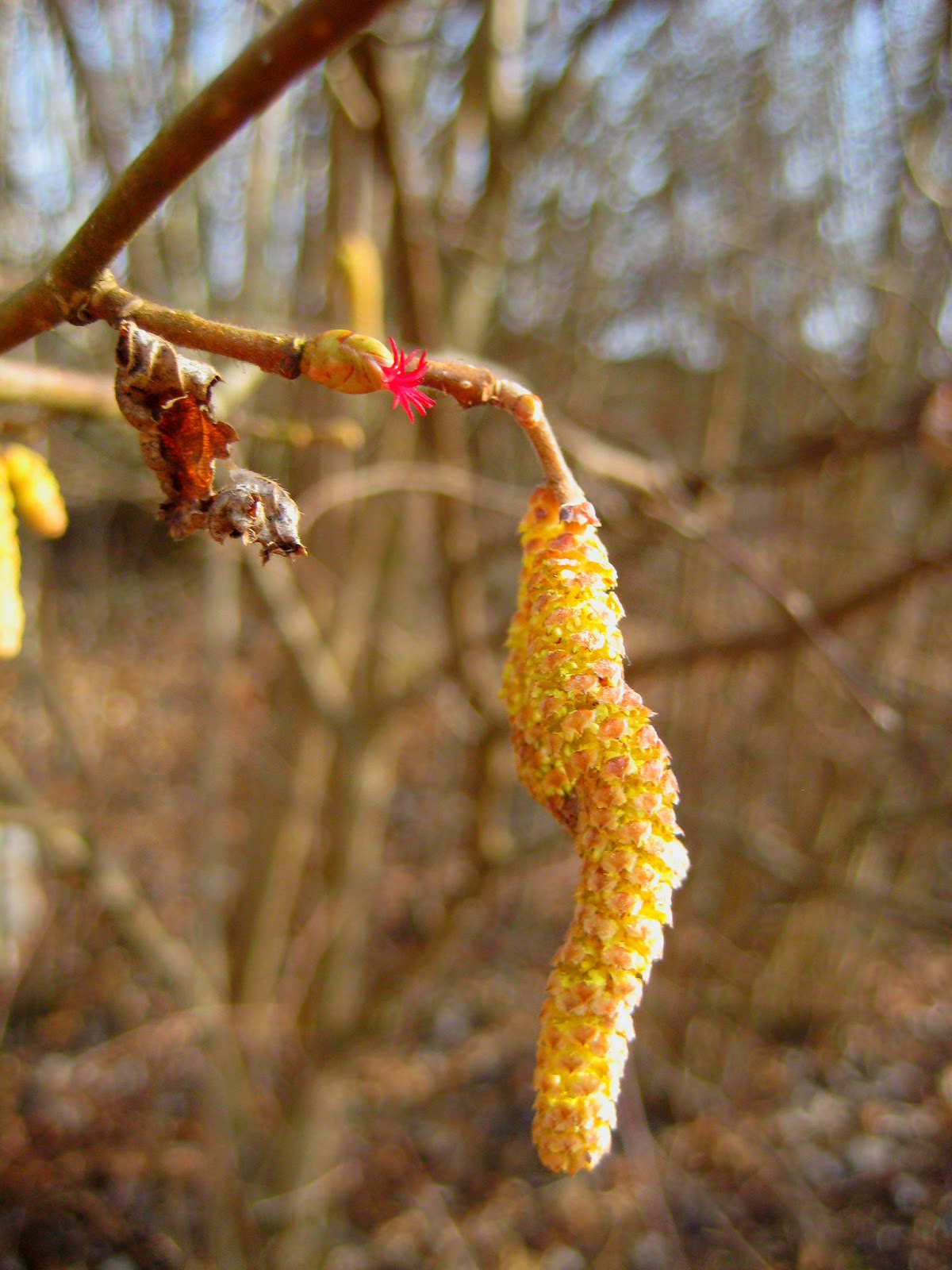
This photo was taken last week. The Hazel flowers have started to wither and I am worried that we will not have many hazel nuts this year because I havent see not even one Bee on them and I have looked and looked and looked ... I think the weather was still too cold for the bees yet Hazel was the first to bloom this Spring. Lets hope Im wrong.

Wednesday, April 17, 2013

Mykorrhiza is building a Kenya Top Bar Hive

Network Mykorrhiza decided to start keeping bees in horizontal Kenya-style Top Bar Hives. They have already built one in the city of Malmo and this new one will be placed in the Agriculture University of Alnarp. This is a HUGE step towards natural beekeeping in Sweden where most beekeepers keep bees in bee-unfriendly framed hives.
Naturally built top bar comb with various cell size, without the use of mono-cell wax foundation.
My smile sais it all :)

In top bar hives the bees are free to build their own comb cells size and are not limited to the frames. Top Bar Brood Comb is usually hanging free from the top bar and the sides are not attached to the walls (except the heavy honey comb) which allows bees to communicate with each other by vibration (when performing the waggle dance). It also gives freedom to bees to build any kind of cell size they feel is needed and they are allowed to have AS MANY DRONES as they feel necessary. The Queen is free to roam the whole hive. The colony is NOT FORCED to make lots of honey by placing extra supers on top of them. When opening the hive one doesn't remove the whole roof like one does in the conventional vertical hives, releasing the hive atmosphere. In top bar hives one opens only 2-3 top bars while the rest is closed. Bees hardly notice the beekeeper when performing an inspection.

Im so happy to see that people are willing to go the bee friendly way rather than focus on making huge amounts of honey :)
 we decided to build this hive from reused materials. We have found a few wooden pallets. It took us some time to dismantle them.Johanna and Marco working hard.
 Marco and me assembling the hive body. He was doing all the hard work I was just there to make the photo look pretty ;)
 The finished top bar hive body with a follower board in place and some top bars (we need to rip a few more top bars)
 the V-shape of the Kenya Top Bar Hive
and here is the finished Kenya Top Bar Hive with legs which make it more ergonomic. Even people with back problems can work this hive. Many old beekeeper stop keeping bees because their backs cant lift boxes used in vertical hives. According to Phil Chandler many women are attending his top bar hive courses and as they say to him "thanks god there is a hive which doesn't require heavy lifting".
We didnt have enough time today to finish the roof and we have to decide on the entrance placement. 
Marco standing proudly behind the hive. This Top Bar Hive will be his responsibility.
Im happy I could help Mykkorhiza to build this hive. I hope to see more of such work shops.