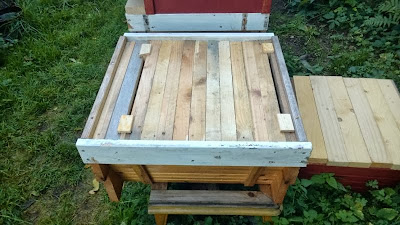
One interesting thing I observed yesterday; I saw a honeybee on a Solidago plant! Solidago was flowering very strong all the summer and I could not see even one honey bee on its flowers only hover flies. Now I saw one plant with a few honeybees working its flowers :) I don't think honeybees like this flower that much but now there is little to be found in the nature so they are using all they can find.
Natural Beekeeping
Top Bar ApiRevolution has begun! Lets make some inexpensive Top Bar Hives and let them be pesticide free on their own natural comb! Che Guebee is a rebel bee fighting for the survival of the Biodiversity we all depend on and which is seriously endangered by deforestation and mono-crop agriculture! What kind of teaching have you got if you exclude nature?
Monday, September 30, 2013
Aster; The Autumn Star
One interesting thing I observed yesterday; I saw a honeybee on a Solidago plant! Solidago was flowering very strong all the summer and I could not see even one honey bee on its flowers only hover flies. Now I saw one plant with a few honeybees working its flowers :) I don't think honeybees like this flower that much but now there is little to be found in the nature so they are using all they can find.
Saturday, September 28, 2013
Bee-friendly Super Top Bar Hives got legs
I have made tall enough legs for my Bee-friendly Super TBHs so I can work without bending my back. I find this very comfortable indeed and will always have this feature in my apiary.
Now that they have legs I hope they wont run off ;)
In case you wonder why I didn't paint the top bar hive body with red paint
its because I already varnished them this summer with Linseed oil and beeswax.
The red paint is the left over from painting our cottage.
Thursday, September 26, 2013
Stop killing Varroa! Instead let Varroa and bees co-adapt to each other!
Thomas D. Seeley
Department of Neurobiology and Behavior, Cornell University, Ithaca, New York 14853, USA
(Received 21 January 2006 - Revised 23 April 2006 - Accepted 23 April 2006 - Published online 29 November 2006)
Abstract - Feral colonies of European honey bees living in the Arnot Forest, a 1651-ha research preserve in New York State, were studied over a three-year period, 2002 to 2005. This population of colonies was previously censused in 1978. A census in 2002 revealed as many colonies as before, even though Varroa destructor was introduced to North America in the intervening years. Most colonies located in fall 2002 were still alive in fall 2005. The Arnot Forest colonies proved to be infested with V. destructor, but their mite populations did not surge to high levels in late summer. To see if Arnot Forest bees can suppress the reproduction rate of mites, colonies of Arnot Forest bees and New World Carniolan bees were inoculated with mites from an apiary and the growth patterns of their mite populations were compared. No difference was found between the two colony types. Evidently, the stable bee-mite relationship in the Arnot Forest reflects adaptations for parasite (mite) avirulence, not host (bee) resistance.
Source
Prof. Seeley is the leading expert in swarm behaviour and feral bee biology. As you can see from his study above Varroa and bees can develop a stable relationship with each other if we let them do so. But if we disrupt it every year by trying to kill Varroa with so many different methods we only breed a stronger, more virulent mite.
Study in Kenya showed that most colonies had Varroa in the hives yet not even one beekeeper EVER noticed any issues. So we can conclude that it is not Varroa that is the culprit but the virus introduced through Varroa presence. Not all Varroa mites are virulent as both the Kenya case shows and Seeley too.
Many experienced "treatment free" beekeepers have come to the same conclusion. The more one treats against Varroa the more virulent it gets. A perfect example are beekeepers who treat every year yet many of their colonies die anyway! Is this not so?
My last years mentor treats every year with Oxalic Acid as most beeks do around Scandinavia yet last winter he had 50% losses and year before that 80%. One treatment free beekeeper in his area didn't have any losses in the last 5 years.
I know of others who treat every year and still lose colonies every winter.
Whats great with feral colonies is they are free from human manipulations. No one ever opens their cavity. Instead of wax foundation with mono-cell size they build natural comb with various cell size. They can have as many Drones as they feel like yet still as the study shows Varroa and bees co-adapted.
There so much wrong with conventional beekeeping I don't even know where to begin! Drone culling, mono-cell size wax foundations, "religious" anti-varroa treatment every year, overworked bees for honey gain, migratory pollination of mono-crops, sugar feeding, swarm suppression, artificial insemination of queens, etc etc etc ...
Its all about our own deformed perspective really. We humans seem to be the ones behind all major issues on this planet. We are to treat our own minds with something rather than Varroa. We have indeed disconnected from the Natural with our "American Dream" lifestyles. I dont know about you but Im ready to re-connect. I will let my bees lead me back home, I'm sure they know the Way.
Department of Neurobiology and Behavior, Cornell University, Ithaca, New York 14853, USA
(Received 21 January 2006 - Revised 23 April 2006 - Accepted 23 April 2006 - Published online 29 November 2006)
Abstract - Feral colonies of European honey bees living in the Arnot Forest, a 1651-ha research preserve in New York State, were studied over a three-year period, 2002 to 2005. This population of colonies was previously censused in 1978. A census in 2002 revealed as many colonies as before, even though Varroa destructor was introduced to North America in the intervening years. Most colonies located in fall 2002 were still alive in fall 2005. The Arnot Forest colonies proved to be infested with V. destructor, but their mite populations did not surge to high levels in late summer. To see if Arnot Forest bees can suppress the reproduction rate of mites, colonies of Arnot Forest bees and New World Carniolan bees were inoculated with mites from an apiary and the growth patterns of their mite populations were compared. No difference was found between the two colony types. Evidently, the stable bee-mite relationship in the Arnot Forest reflects adaptations for parasite (mite) avirulence, not host (bee) resistance.
Source
Prof. Seeley is the leading expert in swarm behaviour and feral bee biology. As you can see from his study above Varroa and bees can develop a stable relationship with each other if we let them do so. But if we disrupt it every year by trying to kill Varroa with so many different methods we only breed a stronger, more virulent mite.
Study in Kenya showed that most colonies had Varroa in the hives yet not even one beekeeper EVER noticed any issues. So we can conclude that it is not Varroa that is the culprit but the virus introduced through Varroa presence. Not all Varroa mites are virulent as both the Kenya case shows and Seeley too.
Many experienced "treatment free" beekeepers have come to the same conclusion. The more one treats against Varroa the more virulent it gets. A perfect example are beekeepers who treat every year yet many of their colonies die anyway! Is this not so?
My last years mentor treats every year with Oxalic Acid as most beeks do around Scandinavia yet last winter he had 50% losses and year before that 80%. One treatment free beekeeper in his area didn't have any losses in the last 5 years.
I know of others who treat every year and still lose colonies every winter.
Whats great with feral colonies is they are free from human manipulations. No one ever opens their cavity. Instead of wax foundation with mono-cell size they build natural comb with various cell size. They can have as many Drones as they feel like yet still as the study shows Varroa and bees co-adapted.
There so much wrong with conventional beekeeping I don't even know where to begin! Drone culling, mono-cell size wax foundations, "religious" anti-varroa treatment every year, overworked bees for honey gain, migratory pollination of mono-crops, sugar feeding, swarm suppression, artificial insemination of queens, etc etc etc ...
Its all about our own deformed perspective really. We humans seem to be the ones behind all major issues on this planet. We are to treat our own minds with something rather than Varroa. We have indeed disconnected from the Natural with our "American Dream" lifestyles. I dont know about you but Im ready to re-connect. I will let my bees lead me back home, I'm sure they know the Way.
Wednesday, September 25, 2013
Poem
Last night as I was sleeping,
I dreamt - marvelous error! -
that I had a beehive
here inside my heart.
And the golden bees
were making white combs
and sweet honey
from my old failures.
- Antonio Machado
(1875 - 1939)
Honeybees feeding on Apples
Honeybees don't just feed on flowers. They are also known for feeding on the Honeydew from Aphids but also on ripe fruits like Apples which are rich in fructose. Since Honeybee mandibles aren't as strong as those in Wasps or Hornets they feed on apples which have fallen to the ground and are broken.
| Honeybees feeding on a ripe Apple in September |
Pollen creates Vitellogenin fat reserves for the winter
I am learning alot about bee friendly plants, shrubs and trees this year. Bought some books, read web pages, planted some, tested some but the greatest teacher so far are the bees, showing me the flowers they prefer in nature. I let some of my kitchen garden veggies go into bloom so to get seeds for the next year and bees seem to like some of these.
Amongst them are Radishes and bees seem to love their flowers.
| Radish flowers are great source of nectar and pollen in Autumn |
Radishes are easy to grow and I will collect many seeds this year for the next season. Brassica family is another late bloomer. Our Mizuna Cabbage is blooming now as well as Broccoli and I see bees pollinating their flowers.
Aster is another plant which flowers in Autumn. Not to forget the fabulous Himalayan Balsam which seeds I started collecting big time :)
Autumn is the very last train for bees to collect pollen and nectar before the cold of winter. For that reason I will focus a lot to plant what's blooming between the August and October. According to some studies bees which have good Autumn source of pollen are the ones best fit to survive winter. Without pollen bees can't "fatten up" for the winter.
| Honeybees on Aster flowers at the end of September (shade temperature 9'C) |
"Bees not only store pollen and honey in the combs, but they also store food reserves in their bodies. This is done mainly in the form of a compound called “vitellogenin.” vitellogenin is classed as a “glycolipoprotein,” meaning that is has properties of sugar (glyco, 2%), fat (lipo, 7%), and protein (91%) (Wheeler & Kawooya 2005). Vitellogenin is used by other animals as an egg yolk protein precursor, but bees have made it much more important in their physiology and behavior, using it additionally as a food storage reservoir in their bodies, to synthesize royal jelly, as an immune system component, as a “fountain of youth” to prolong queen and forager lifespan, as well as functioning as a hormone that affects future foraging behavior!"
Thanks to Vitellogenin bees can live long throughout the winter. No wonder that beekeepers have huge winter losses in apiaries close to mono-crop agriculture using Neonicotinoid pesticides. Such pesticides affect the bees ability to create fat reserves. Without fat reserves in their bodies they have very little chance to overwinter successfully.
So its not just honey/sugar they need to overwinter but ample amounts of pollen too to build up fat reserves in form of Vitellogenin. Can bees find enough pollen in Autumn if surrounded with mono-crop fields which give no pollen at all at this time of the year? I don't think so! And because of this it is of great, ney, alerting importance to plant for the bees as much as possible personally but also to try and make our politicians understand how important it is to create a sustainable biodiverse environment. Farmers will not change their habitual perspective of only thinking about profit so we must have a program to assist farmers to plant around their fields bee friendly plants, shrubs and trees to sustain the bees throughout the whole year. Large scale mono-cultures as seen in California Almond fields is to be banned in my opinion. They represent Eco-cide on grand scale and are showing us year in, year out that they are nothing more but deserts for the insects and birds.
So join your local environmental group and try to make a difference in your locality, your village, town, county. We are on the verge to destroy life on earth as we know it! Lets not fool ourselves by ignoring this fact and running away from it into our TV shows, PC games, various hobbies and other entertainment, etc ... Even if you choose to ignore them, facts still remain (I think Huxley said that).
Read more about the importance of Vitellogenin HERE
Monday, September 23, 2013
Bee-friendly Super Top Bar Hive
As I already mentioned in one of my earlier posts I'm designing a new bee hive one that in my opinion suits well the bee biology and my needs as a householder. I'm not after large amounts of honey otherwise I would be keeping bees in those conventional hives which overwork bees, making 70-100 kg of honey. Im more after a modest amount of around 10-15 kg per hive. But first and foremost Im into giving my bees a cavity which suits their natural biorhythm.
The main starting point in my personal beekeeping is the fact that bee swarm prefers to settle in cavities which have a volume of 40 liters. Dr. Seeley's study of swarm behaviour demonstrates that swarms, if offered cavities between 15 to 100 litres always chose 40 litres cavities. There must be a good reason for that and Im intending to respect that preference. Im not sure what the exact volume of my short Top Bar Hives is but there are 10 top bars and each can hold a comb with close to 2 kg of honey so Im assuming it is around 40 litres because Seeley noticed that swarms in such a cavity can collect around 20 kg of stores before winter.
Supered hive is not a new thing. Far from it. It was used for decades. Most beeks these days keep bees in such supered vertical hives. They are designed so to give as much honey harvest as possible. Design for the benefit of humans rather than bees. In such hives bees are obviously overworked by filling all these empty supers above their heads. Bees dislike empty space and will do their best to fill it with combs and stores. I would not say that the colony is trying to make a surplus of honey but rather they are trying to thermo regulate the entire cavity. The honey comb is not just their food but also a material which is very good at preserving heat, so we might say bees heat up the wax comb which preserves the heat and reflects it back onto the colony keeping them warm. Hive is a wind break and a protection from predators and rain.
I also mentioned in my earlier post that one swedish beek tried this design and got good results with it. He got 24 kg of honey from his super top bar hive but Im sure its because he had frames in his supers so he could easily extract the honey and return the empty combs for the bees to keep refilling them so to harvest again. Im more into crush and strain where honey comb is crushed entirely to extract the honey. For this reason I will harvest only once a year.
You might wonder why Im testing this design since I keep bees in horizontal TBHs which are already bee friendly. Good question :)
Yes they are indeed bee friendly and for that reason I have chosen to keep the top bar hive model for the Primary Colony Body/Cavity. As mentioned above Im trying to give bees a cavity of about 40 litres (Dr. Seeley) and all horizontal Top Bar Hives are much larger than that. Yes one could make them smaller with the follower board but where will the bees store the surplus honey then?
You see, bees do feel their cavity/body size and act/plan according to that volume. My local inspector overwinters small splits on only 2 combs every year. These small splits seem to adapt to this small cavity and raise just enough bees and store just enough honey to pull them through the winter until the first pollen and nectar source in early spring. His small splits survive the winter on 2 combs. Fact.
But swarms do prefer 40 litres cavities and that is my starting point in designing this new hive (new for me that is).
That said bees in the regular size Top Bar Hive can sense that large space and will begin raising a lot of brood which is to fill that space with comb and stores. And here is my dilemma; how do I know what is the surplus honey that I can harvest for my own needs? You see, bees can store the same amount of honey on 10 combs as on 15 combs. On 10 combs they will store maybe 2/3 of the comb with honey and on 15 combs 1/2 of the comb. Bees always store honey in the upper part of the comb leaving some empty space at the bottom part (brood raising?). So if I believe that bees need only 10 combs to survive the winter I will very likely have to feed extra since the hind combs are the ones with most stored honey, hence called the honey area. These combs can be filled entirely with stores, not so in the brood area. So how do I know for certain that bees have enough stores if I harvest the combs with most honey in them? Bees sure arranged the whole cavity/body so its set up for the wintering yet I took away that which I believed was surplus.
A colony in a 40 litres cavity will raise less brood than those in a conventional hive and will very likely backfill the brood nest faster than those in conventional hives and for that reason will very likely go into swarming preparation much earlier. That is fine with me since early swarming also means more time for the new colony to build up before the winter.
| Bee-friendly Super Top Bar Hives |
1. its a top bar hive where bees have freedom to build natural comb with various cell size
2. the colony is not exposed to the super above since the top bars are not spaced as is the case in framed hives, and hence is not forced to fill it up with comb and stores pronto
3. there is no queen excluder
4. when the super is removed the brood nest atmosphere is preserved because the top bars aren't spaced
5. the bees feel there is a primary larger cavity and there is smaller/shallower secondary cavity. They will choose the larger (40 litres) cavity and will make sure to organise that cavity so its ready for the winter (filled with enough stores). This cavity will also dictate to a certain extent the swarming urge and the amount of brood raised during the flow and before the winter (less brood).
The secondary cavity (super) can be closed off by propolising the two 1 cm slits (second photo bellow) or if Receiver Bees (which receive nectar from foragers) decide there indeed is some surplus honey they will store it there. Im sure the bees will have more choice in such a design. If bees decide that they have better things to do than to fill that secondary cavity with honey they can easily close it off with propolis.
6. the primary cavity is never changing in volume. Supering, Nadiring and Spacing (comb manipulation in most hives) changes the hive volume all the time which forces changes on the colony level. I will do no spacing manipulation in this kind of hive.
Even though some people believe that we humans and bees are "One" (and this can be true in a mystical and spiritual way) Im approaching this hive design as if we humans and bees are not "One" but rather two different species entirely. For that reason I find it highly appropriate to have two separate cavities, one for the bee colony and one for the wretched human, my-little-self :) so none of us get confused with my hive management.
Subscribe to:
Posts (Atom)