

Friday, September 13, 2013
Che Guebee Drone won the contest in the Danish Bee Magazine
My photo of this gorgeous Drone won the contest in the Danish Beekeeping magazine Biavl this year :)

Strong September Flow
Despite the good weather and strong honey flow this summer I decided to feed the bees with sugar syrup. I begun feeding them in August with 5:3 sugar syrup mixed with Nettle Tea and a tiny amount of Apple Cider Vinegar, and by now their combs are filled up with stores. So far I fed my 6 colonies with 88 kg of sugar.
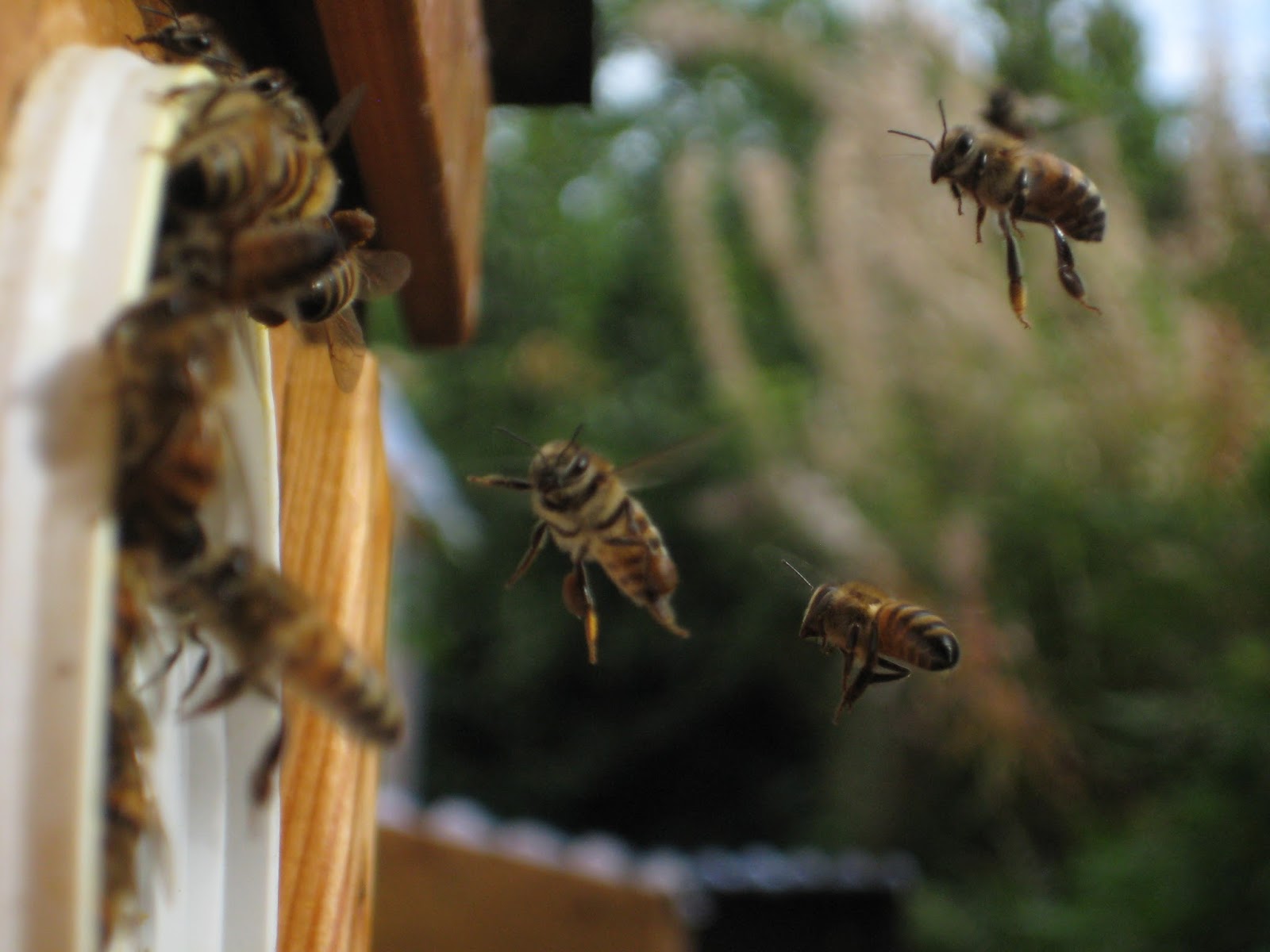
These pics are taken today and as you can see the returning bees are numerous

There is lots of orange (Hawksbeard), yellow (Aster and Water Lilly) and light grey (Himalayan balsam) pollen coming in.
.JPG)
This comb is clearly totally filled with stores. The cells are cupped to the edge of the comb from top to bottom.
Some people asked me how much honey did I harvest this year and I say 8 kg from 2 colonies. When they hear about me feeding them with 88 kg of sugar they question the type of Kenya Top Bar Hive.
What some don't understand is that I bought this year 2 colonies and divided them into 6 colonies, by making splits. This weakens the mother colonies a lot in the "excess honey making" aspect.
If I decided not to do splits I would have had honey to harvest but instead of honey I have 4 more colonies and let me remind you each colony cost 2000 swedish crowns which is approx 200 Euros so even if we are to look at the economics of beekeeping I have won much this year.
Just for the record I made splits for the bees sake not for my own monetary gain. The world of bees is being hammered very hard at this time thanks to our use of pesticides and mono-crop agriculture and they need all our help to get them back to health. Bees swarm every year naturally and that is what I did, I swarmed them so they have a bigger chance to survive the coming winter and other environmental challenges.
Top Bar Beekeeping is by far the best way to give actual freedom back to the bees on a colony level. Bees don't build mono-cell combs as offered by the conventional beekeepers. In my hives I see all sort of cell size from 5,6 mm to 4,6 mm. Only bees know why they prefer such biodiverse cell structure and we must respect their very biology. And since bees prefer biodiversity I think its time for us humans to change our mono-crop fields which are nothing more but deserts for bees, into agriculture based on biodiversity.
Its time we get our shit together! We must act now and make pressure on our governments to make the change but also be the change ourself.
Monday, September 9, 2013
Preparing the new Supered TBH
I'm trying to find a design which suits both the bees need and my needs as self-sufficient homesteader. I love honey but so do bees. If sugar is much better than honey then why don't we choose sugar over honey ;)
I just find it wrong feeding the Honey Makers with sugar syrup so looking for a way to satisfy both my self and my ladies.
As I mentioned earlier I have a feeling that constant supering/nadiring/spacing has the effect of creating large colonies. Beekeepers know this and look at it in a positive way. I don't. Not anymore.
The more bees in the hive the more stores they need to overwinter. Some beeks overwinter small colonies on only 2 combs (under 4 kg stores). Dr. Seeley finds in his swarm behaviour study that bees prefer cavities about +/- 40 litres not bigger nor smaller. Our hives are usually much bigger throughout the season tricking bees into feeling the colony body is large so they try to fill it with extra bees to do the excess work. This results in too many bees going into winter. These are only my hypothesis, I could be wrong.
Any way, I have started preparing 1 suoer per each TBH in which bees can store the excess honey. This super is not "aggressive" since it has only one opening so bees in the brood area doesn't feel the space above being empty. This will make sure bees focus mainly in the bottom part to prepare it for the winter and if the honey flow is very strong the house bees will have the choice to fill the super with honey ... or not.
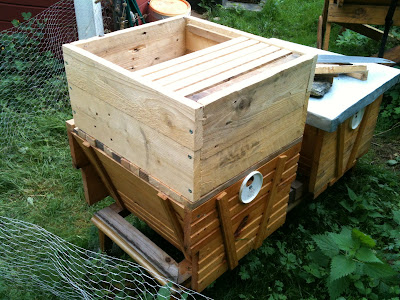


I just find it wrong feeding the Honey Makers with sugar syrup so looking for a way to satisfy both my self and my ladies.
As I mentioned earlier I have a feeling that constant supering/nadiring/spacing has the effect of creating large colonies. Beekeepers know this and look at it in a positive way. I don't. Not anymore.
The more bees in the hive the more stores they need to overwinter. Some beeks overwinter small colonies on only 2 combs (under 4 kg stores). Dr. Seeley finds in his swarm behaviour study that bees prefer cavities about +/- 40 litres not bigger nor smaller. Our hives are usually much bigger throughout the season tricking bees into feeling the colony body is large so they try to fill it with extra bees to do the excess work. This results in too many bees going into winter. These are only my hypothesis, I could be wrong.
Any way, I have started preparing 1 suoer per each TBH in which bees can store the excess honey. This super is not "aggressive" since it has only one opening so bees in the brood area doesn't feel the space above being empty. This will make sure bees focus mainly in the bottom part to prepare it for the winter and if the honey flow is very strong the house bees will have the choice to fill the super with honey ... or not.
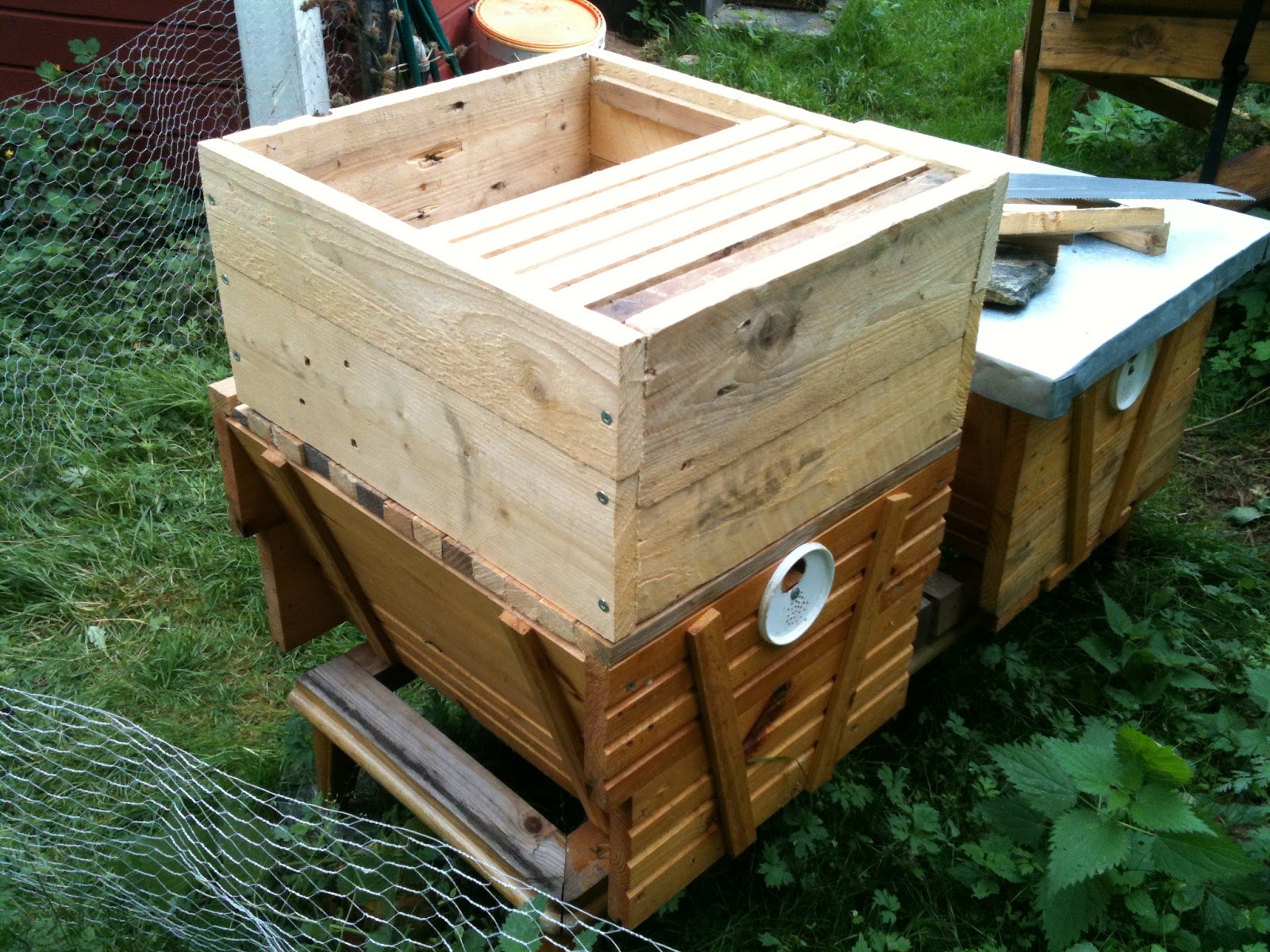
This super is too tall/deep. I plan on making 10 cm tall super because
Queen dislike laying eggs in such a small space.

1cm Spacers for the entrance into the super making sure the sides are
closed so no robbing can occur.

This opening is placed just above the actual top entrance.
Im still not sure if Im to have the opening at back, or front
or both. The most important thing is that the brood nest is cover
at all times. I feel this kind of super is not forcing bees into
storing nectar into it but rather using ONLY if the honey
flow is truly strong. Lets test this next year.

Our chicks guarding the Apiary :)

I have spotted one Hornet snatching a flying bee every now and then.
One can still see the pollen on this poor bee's legs.
Friday, September 6, 2013
"Holma Forest Garden" & "Urban Gardening Network Seved" visiting Che Guebee Apiary
My ladies and I had a visit yesterday :) The fine folk of Holma Forest Garden came to see Che Guebee Apiary which consists of 6 colonies in horizontal Top Bar Hives.
photos by Martina
Holma Forest Garden are interested in this (for Sweden) strange way of keeping bees and have decided to give top bar beekeeping a try in their forest garden next year.
I will help them build their first top bar hive on the 6th of October.
There were also two persons from the Urban Gardening Network Seved showing interested in this method, especially because they have a few people in the network which come from Somalia were top bar beekeeping is very normal.
 |
| Welcome to Che Guebee Apiary :) |
.JPG) |
| Talking about top bar beekeeping |
 |
| Newly started natural top bar comb |
.JPG) |
| careful top bar comb manipulation |
 |
| Normal kitchen bread knife as a hive tool |
 |
| This comb is from a conventional hive which was introduced into the TBH via Chop'n'Crop. For some reason bees didn't feel like building it into the shape of the cavity. The spray bottle is used instead of a smoker. |
 |
| Inspecting comb for eggs and larvae |
Wednesday, September 4, 2013
Conventional Farmers ain't all bad
Natural beekeepers are known to dislike conventional farming practices but in this case some of the stuff they do seems helping the bees at this time of the year in my locality.
At one stage the farmers have cut down all the grass on their fields for hay production, cutting down the Clover flowers as well. This made me sad because at that stage Clover was the only one flowering a lot.
The bees have considerably reduced flying after that.
Another thing happened when farmers cut down the grasses; they have cut down the Hawkbit and Hawksbeard plants as well which were just about to start blooming. This have only postponed their flowering and the fields now are all yellow. It feels like the beginning of Dandelion nectar flow back in May :)
 |
| fields covered in Hawkbit flowers |
 |
| Lots of pollen |
 |
| Honey extracting nectar with proboscis |
 |
| Bee flying from one flower to the next ... |
 |
| Sisters in action |
But not all looks great on the farmers fields. Most of the farmers till their grass fields once covered with Dandelion and Hawkbit plants because they believe that such plants give no benefit to their cattle. They only want grass and to make that possible they first spray the field with poison called RoundUp which kills literally all plant life. After that they till the land and after some time they saw new grass seeds. Such fields will not offer anything to the pollinators until Dandelion and Hawkbit seeds find their way back onto those fields. This can take several years.
And here we see the problem arising from not keeping landrace cattle which can thrive on flowering fields. The swedish landrace cows are small and give less milk than the imported ones but they also need no extra feeding, no need for high quality grass diet.
Think about it. We will buy a farm soon and I will make sure we only have landrace animals, which are adapted to this climate and nature.
Tuesday, September 3, 2013
Farmers Awakening

A farmer wept one tear
in form of a bee
opening his heart
with the long lost key
Deep is the ignorance
placed behind his eyes
because of his greed
the little bee dies
"How did it come to this?"
the farmer asks in despair
"Because of my greed bees die
That is not fair!"
"I must find the way
to save the honey bees
I will turn my mono-crop fields
into bee friendly trees."
Monday, September 2, 2013
Feeding bees with Nettle Tea and Sugar Syrup
I dislike feeding white refined sugar to the bees, I really do and I'm trying to find a way to manage some amount of honey for our household and to leave enough for the bees. I am trying to manage this by not expanding the Body of the Colony = the hive by excess supering, nadiring, spacing.
But since I'm feeding them with sugar now to prepare them for the winter I decided to mix Nettle Tea with the Sugar Syrup to enrich it with all the minerals from the Nettle leaves.
 In the photo above one can see that the sugar syrup is colored now by the Nettle Tea. All Honey has some kind of color to it because of all the minerals in it.
 I'm observing my ladies daily on the hive entrance and through the observation windows. They are so powerful, they have such strong sense of purpose unlike us humans who seem to be lost most of their life.
I think naively that I'm helping them but in truth it is them helping me find The Way.
 They are utterly enjoying working on an entirelly naturally built comb. It is how they wanted it to be. It is them who decoded what cell size is placed where on every single comb and there are so many different cell sizes on those combs. Why do beekeepers keep placing mono-cell wax foundations into their hives? Makes me sad.

But since I'm feeding them with sugar now to prepare them for the winter I decided to mix Nettle Tea with the Sugar Syrup to enrich it with all the minerals from the Nettle leaves.


I think naively that I'm helping them but in truth it is them helping me find The Way.


Subscribe to:
Posts (Atom)