Natural Beekeeping

Top Bar ApiRevolution has begun! Lets make some inexpensive Top Bar Hives and let them be pesticide free on their own natural comb! Che Guebee is a rebel bee fighting for the survival of the Biodiversity we all depend on and which is seriously endangered by deforestation and mono-crop agriculture! What kind of teaching have you got if you exclude nature?

Tuesday, July 30, 2013

Second hive honey harvest and Drone pupae clean up

I almost forgot to blog about this :)
I have harvested honey from another top bar hive couple of days ago. This time I decided to extract the honey with my bare hands instead. I remember doing this as a child at my uncles farm. He kept bees in Skeps and would harvest honey at the end of the season. The whole family would then sit around the bucket with honey comb and we would crush it into a seal to separate the tiny wax parts from the honey. No need for expensive and unsustainable extractors or presses, simple hands will do ;)

 The rain has finally arrived :) flowers cant produce much nectar if its too dry so this rain is very welcome indeed. It will rain tomorrow as well and after that there will be a week of sun and warmth again. I'm expecting the nectar flow to continue.
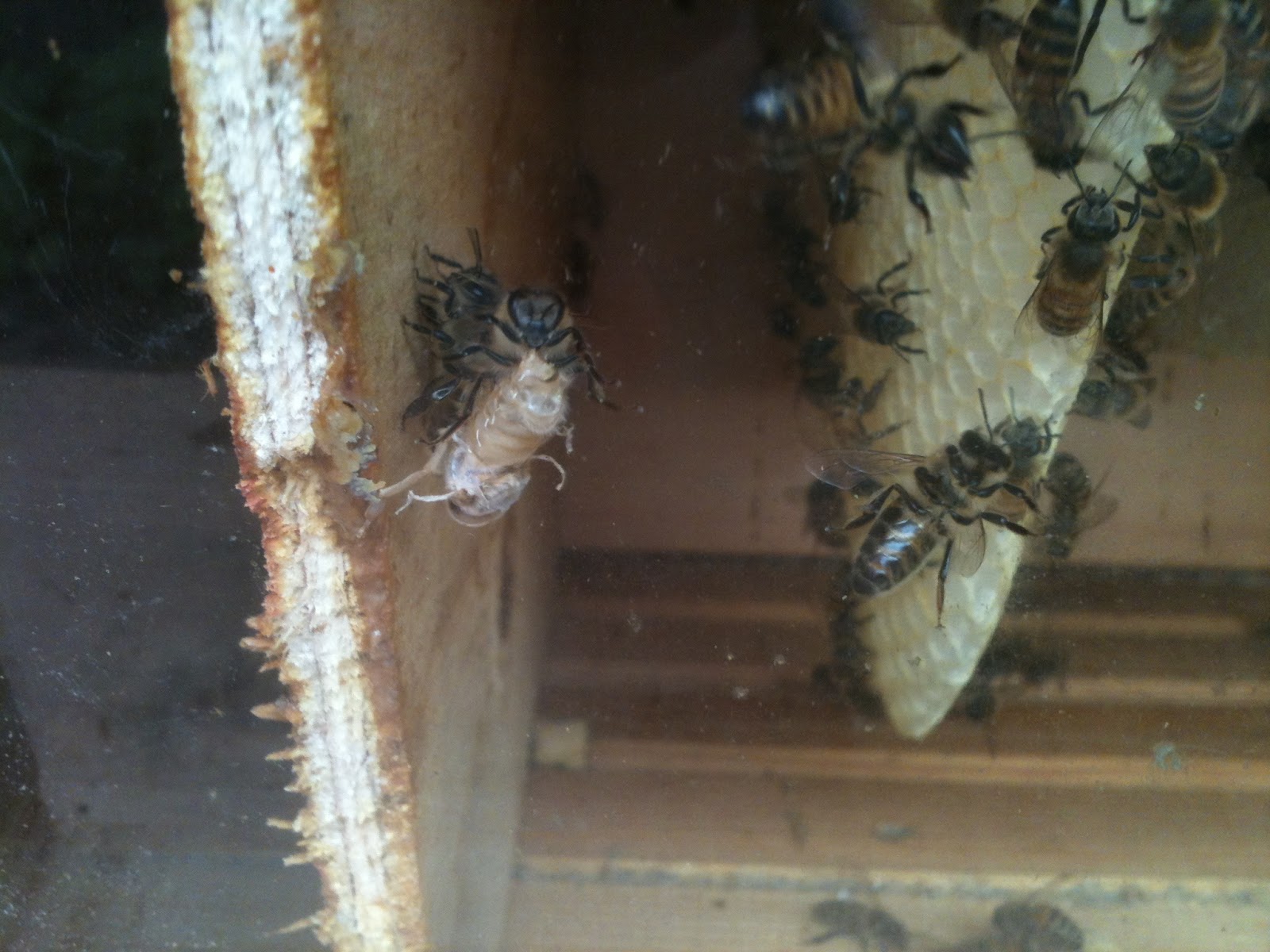
I can see bees throwing out all the Drone Pupae. They have already evicted all living Drones so it was to expect that they will get rid of the remaining Drone brood too.

Sunday, July 28, 2013

Saturday, July 27, 2013

Two eggs per cell

I have inspected all 6 colonies yesterday and found that all but one has eggs, larvae and capped brood. The two smallest splits have pulled through very well I must say and are raising lots of brood :) I did give them extra combs of pollen/nectar and one more capped brood comb from their mother hive (to keep same genes in the colony). This sure helped.

One colony has no larvae nor capped brood and has only two brood combs with eggs. This would not worry me a bit if I didn't spot 2 eggs per cell. Not in all cells though. One comb has only 1 egg per cell. My local beekeeping inspector told me that it is normal for a young Queen (this years queen) to lay 2 eggs per cell until she establish proper laying pattern.

Important to mention is that I have 4 new Queens and all these hives were managed in the same fashion; adding empty top bars on each side of the brood nest resulting in a bigger brood nest. All colonies but this one filled those newly built combs with brood. The hive in question filled those newly built combs with pollen and nectar instead??? I'm puzzled? Why did worker bees in this particular colony decide to fill the brood nest with nectar/pollen when the those in other colonies decided to give that new space to their Queens to lay eggs in it?

I have rearranged their whole nest moving the brood nest closer to the entrance. This colony is the only one which had the brood nest in the middle of the hive all others keep it close to the entrance. I placed two empty top bars on each side of the brood nest in hope that this time they use it for brood raring. I hope the Queen is properly mated since she sure looks nice, long and big :)
I will inspect this colony in a week and see if the eggs have turned into larvae and if they have begun to lay eggs in the newly built combs. If not then I will re-queen.

Another hive has capped most of their surplus honey so I decided to harvest it. I will crash'n'strain it, this time with my hands.
The honey comb can be harvested if its at least 2/3 capped otherwise there
will be too much water in the honey.

Saturday, July 20, 2013

Drone Eviction has Begun

It has begun ... already?!!! I thought that bees will evict Drones in Autumn but not in my top bar hives! They already started killing them and kicking them out even though its only July and the forage is still ok. This could be a very good thing for the colony because at this time of the year Drones are the ones spreading Varroa (which hang on their bodies) from one hive to the next. No Drones No extra Varroa! Not too bad ;)
Just for the record; my conventional beekeeper friends have not yet seen this behaviour in their hives.
 I have noticed yesterday evening that worker bees were after the Drones, killing them. 
This morning I found this scene; Lots of dead Drones!
 Worker Bees cleaning up the mess
The weather is glorious these days indeed but we do need some rain soon

Monday, July 15, 2013

Harvesting the excess honey

How do we define excess honey? Do bees even make excess honey? I'm sure this highly evolved super organism (Bien) is never doing more than they need, but once placed inside a man made beehive all of this changes since we all manipulate bees, more or less, but nonetheless.

Research done by Dr. Seeley shows that feral swarms prefer cavities of 40 liters when given to choose between 15, 40, 60 and 100 liters cavities. Most beehives are much bigger than 40 liters, exception is skeps.

So what does a bee colony do once they have filled the whole 40 liters cavity? Since they need no extra honey once all comb is filled in Summer, what other tasks do they perform? So many bees must be doing something. In two of my hives the bees have filled all the combs with nectar including the brood nest and the Queen has ceased to lay new eggs. Why this break in brood raising?

Is it possible that all these vacant bees take on a new task, like grooming one another because that is the very thing I observed in one of my hives with an observation window. I don't know, but what I know for sure is that the colony is preserving energy which brood raising requires. Fact is that flying forager bees live no longer that 6 weeks because of all the foraging work. Is it possible that worker bees live longer when not flying? If all the cobs are full there is no need to fly and hence the body is not worked to death.

We beekeepers try every kind of manipulation to get them make as much honey for us as possible; some do supering, others nadiring, some checkerboarding, and those with horizontal Top Bar Hives spacing.

Would bees do better is we would stop manipulating them?

I decided to start harvesting what I see as excess honey and that is all the comb behind the 10th comb counting from the entrance. Most beekeepers around here overwinter bees on 10 frames which hold 2 kg of stores each, so 20 kg for a Buckfast bee. Nordic Bee needs less.

I have not yet poured the honey into jars so not sure how much honey I harvested from this one colony but I'm assuming around 2-3 kg honey.
I used a honey press which I've got as a present from my parents-in-law.


Saturday, July 13, 2013

Worker Bee Grooming a Drone

It is known that bees can groom each other but I never heard of worker bees grooming Drones :) It is also known that Drones are the ones to which Varroa is highly attracted to and I have seen one Varroa on a Drone this year (this was outside the hive).

Grooming is a VERY important aspect of honey bee health. Latest research shows that Honey bees exposed to Neonicotinoid pesticide aren't good at grooming each other. Apparently the pesticide blocks the part of their nervous system in charge of grooming. Bayer's Neonicotinoid Termiticide called Premise 200 SC works in this fashion. The Imidacloprid substance damages the nervous system in Termites responsible for grooming. Termites pick up parasitic fungi in the ground and are unable to clean themselves which results in colony collapse (NOTE! Colony Collapse Disorder in Honey Bees).

I have made a short video through the observation window in one of my top bar hives hence the bad quality, where a worker bee grooms a Drone :)

Thursday, July 11, 2013

Checking if the hives are Queen-right


Two days ago I inspected all the hives to see if they have newly laid eggs which indicates that the colony is Queen-right. I opened one after the other and found new eggs :) All Virgin Queens are mated :)
One of the small nucleus hives had no honey stores left so I gave them one comb from a strong hive with honey and pollen and already the next day they started building another comb :)
This small colony had a few cells with dead bees in them but none of the dead bees are in liquid form but rather dry. I'm not sure why they didn't clean those cells. Too few house bees maybe? Anyway I will inspect this hive in a week to make sure those cells are not turning into an American Foulbrood (AFB) which is highly contagious. In case of AFB the whole hive must be burned and the Bee Inspector informed so they can check all apiaries in the 3 km ratio to make sure AFB didn't spread.